
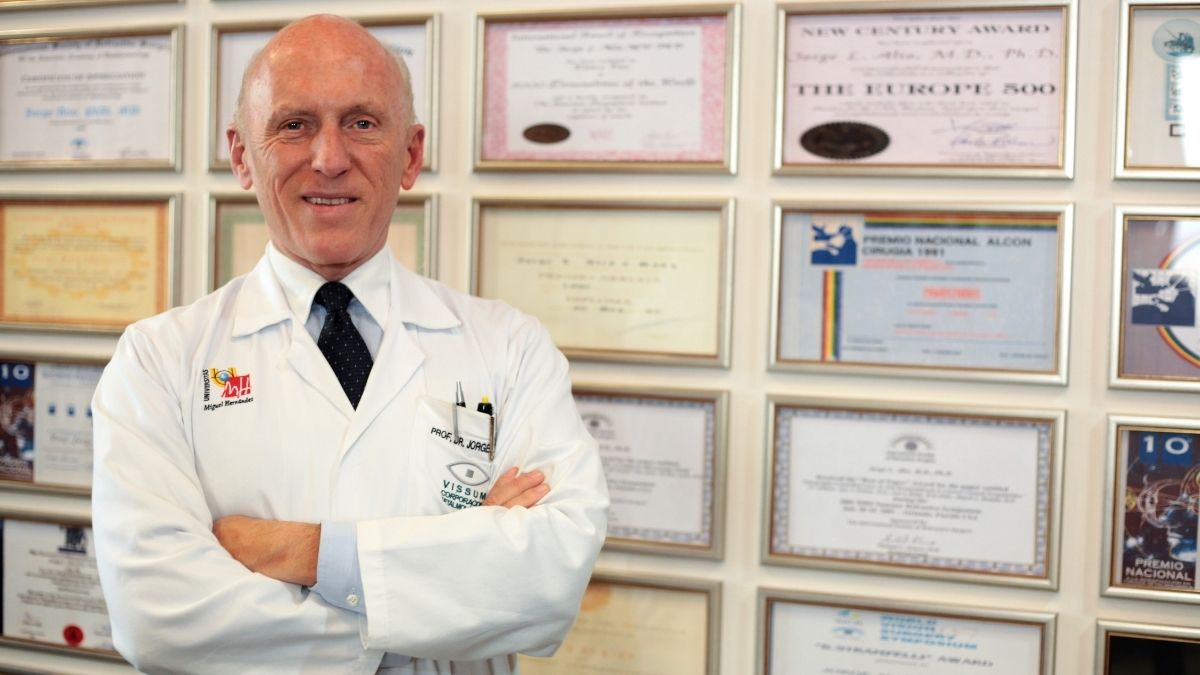
Prof. Dr Jorge Alió elaborates on the need for greater oversight of MIR teaching and for an assessment at the end of the programme, following an interview with Redacción Médica.
For this reason, we share below the reflections of this international specialist in the anterior segment:
I would like to expand on my views, based on my extensive teaching experience and the wealth of information I have gathered over the years, both nationally and across Europe, regarding MIR training in Spain and, specifically, in Ophthalmology.
The demands of undertaking a MIR in Ophthalmology are enormous
In practical terms, you need to have achieved top marks right from nursery school to be able to gain entry to medical school today and, subsequently, secure a place in Ophthalmology, which are very scarce and highly competitive.
Faced with all this demand, once a resident takes up their post, they are met with a complete void. There is no supervision of teaching. Many hospitals do not even hold clinical rounds, where residents can discuss uncertain cases or receive guidance from senior ophthalmologists on the staff.
Furthermore, teaching is uneven. Whilst some centres offer extensive surgical training, in others there are practically no operations. No one is responsible for supervising this teaching and, ultimately, there is no final assessment to validate the training received.
A final examination that assesses learning outcomes is key to teaching
The need for a final examination (known as a ‘Board’ in foreign institutions) is fundamental. No teaching can be considered valid without an assessment of the outcome. This standard, which is required from secondary school right through to the final year of medical school and, of course, during the MIR programme, is completely absent at the end of a long period of residency, during which residents’ futures are at stake.
Whilst other systems, such as the British or American ones, involve continuous assessment throughout the residency and monitor the training received –both surgical and clinical– none of this is currently done in our country.
Therefore, in my capacity as President of the European Academy of Ophthalmology (EAO), I wish to advocate for better oversight of the MIR training programme and, above all, for a final examination at the end of the programme that lends prestige to the qualification of ophthalmologist in Spain, in comparison with other countries where such an examination exists and is recognised.